
Introduction
MitiGate is a cooperative risk management board game for 2-4 players (approx. 60 minutes). Choose a project you are all more or less familiar with. It could be one of your organisation’s projects or a project planned during a training course. If you can’t find a better idea, a “risk management training” project could be an option. A project management team formed by players must deal with risks arising during the project by implementing preventive measures. The goal of the game is to reduce the impact of risks on the project’s general objectives (scope, quality, time, cost) through 3 project phases (initiation, planning, execution).
This is a learning game that teaches qualitative risk analysis, risk categories, risk response strategies, risk and countermeasure examples, and their impact on project objectives. This game can also develop players’ discussion and storytelling skills.
Game Components
This game has:
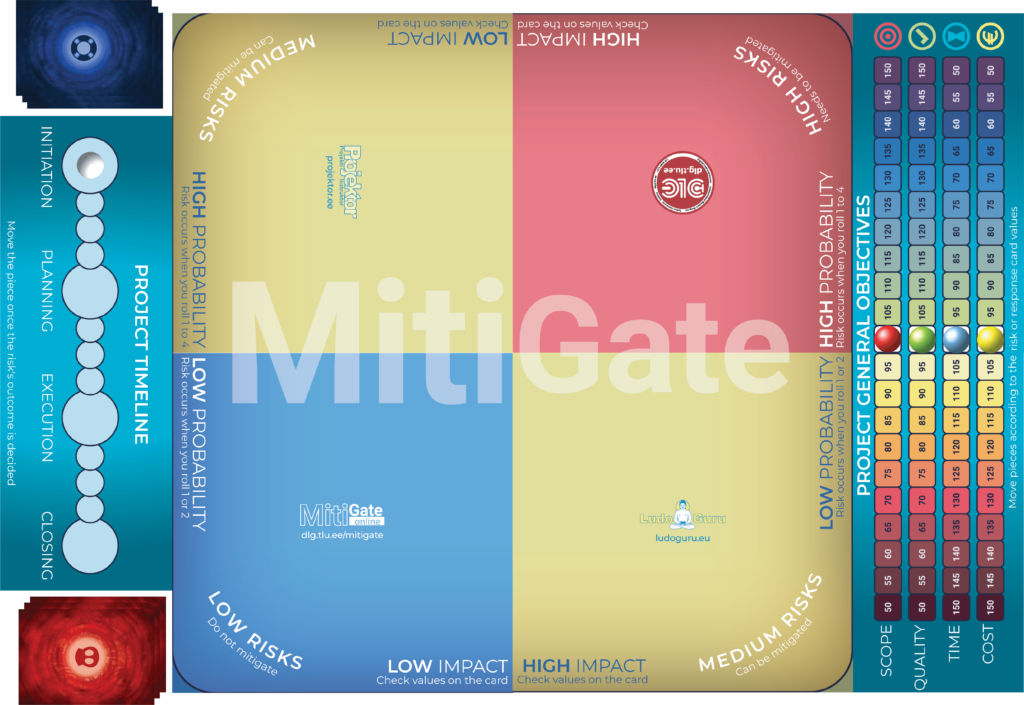
- Game board in 7 pieces: risk impact-probability matrix (4 pieces), project general objectives (2 pieces), project’s timeline or progress board (1 piece)
- 36 risk cards in 4 categories
- 36 mitigation cards in 4 categories
- 5 game pieces and 1 die
Game Board
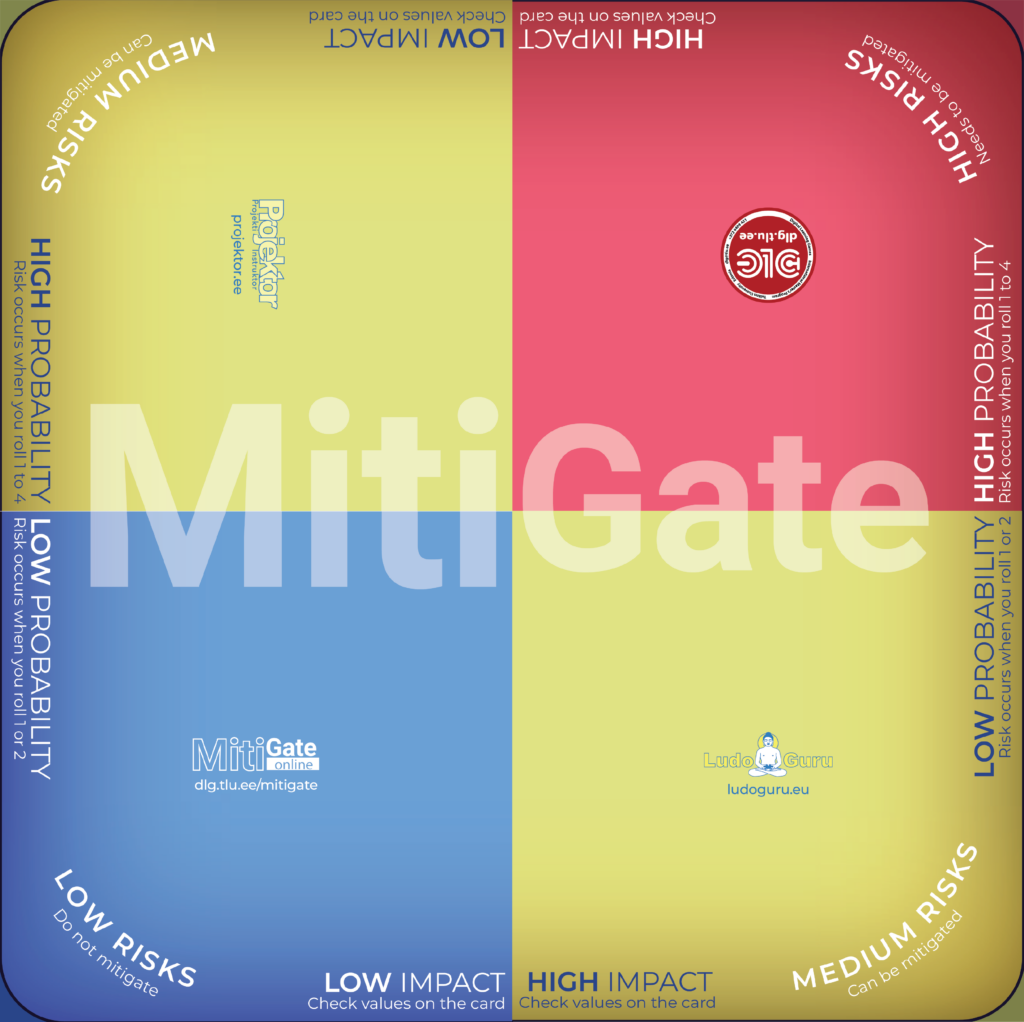
The central part of the game board is the risk probability-impact matrix. This will be used for estimating the size of each risk.
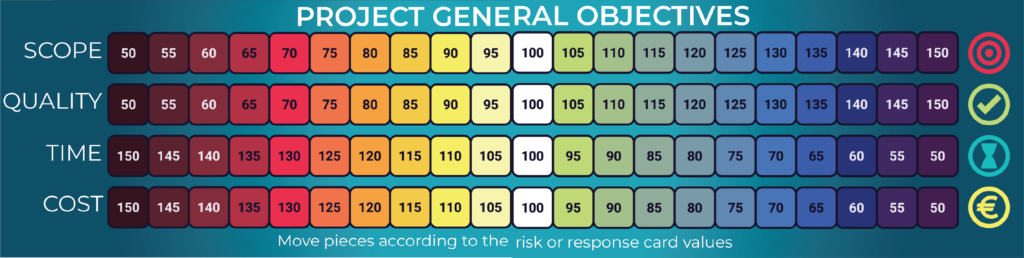
The general objectives of a project (scope, quality, time, and cost) are scales or sliders that represent the health of the project. Risks will reduce the project scope and quality and increase the project duration (time) and cost. Countermeasures move them in the opposite direction (mostly).
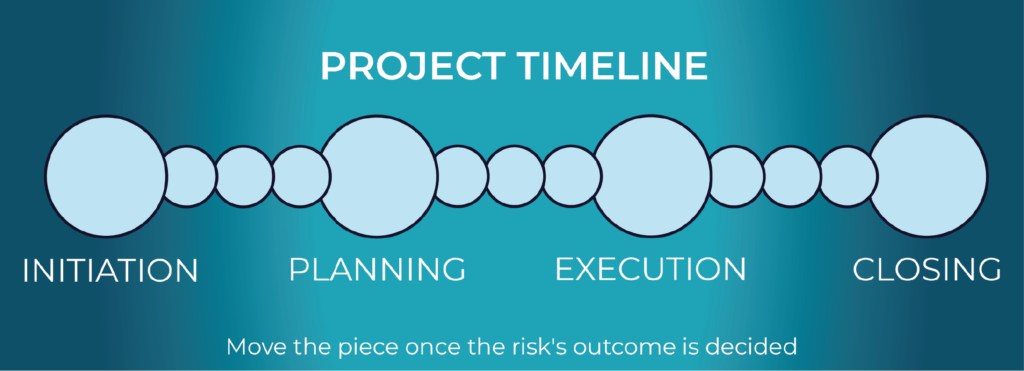
Project timeline represents the project lifecycle with its phases and is used for tracking the players’ progress.
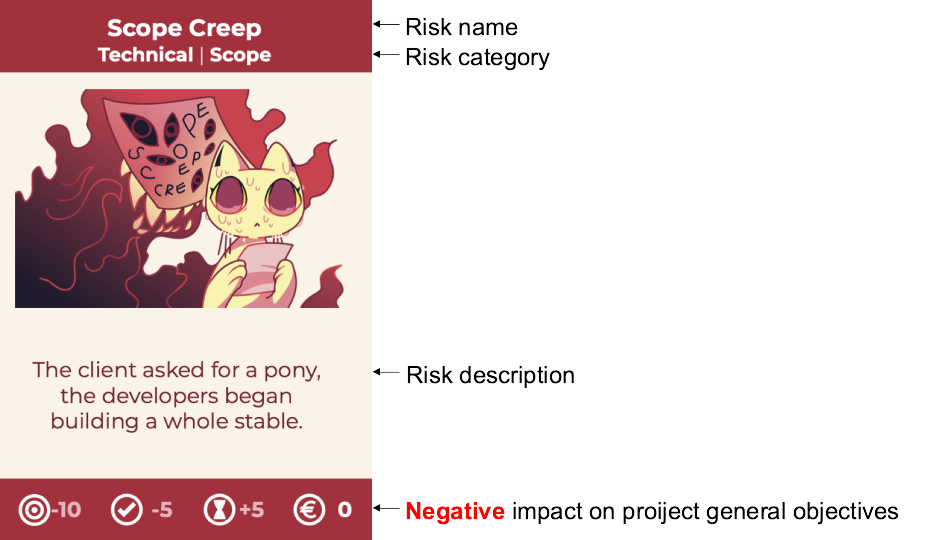
Risk Cards
Here are the details of a Risk Card:
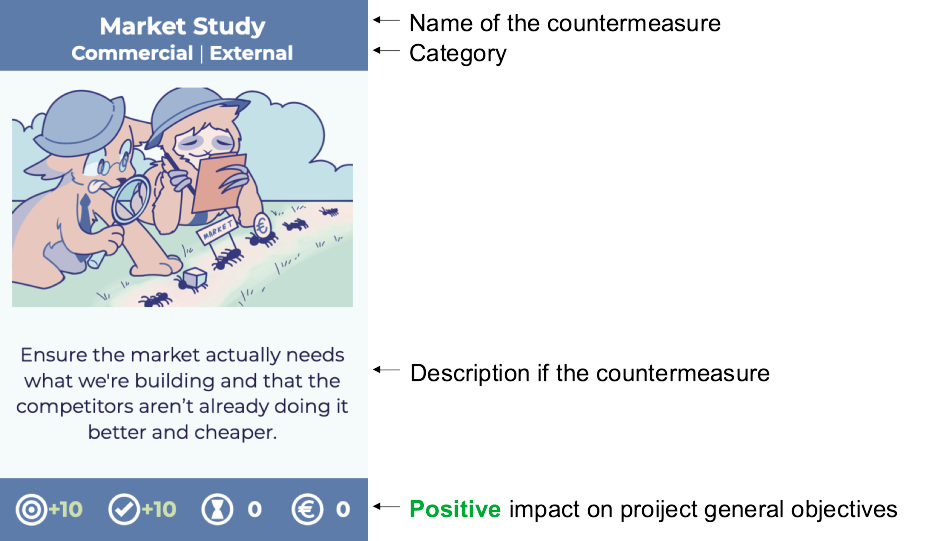
Countermeasure Cards
Countermeasure cards have a similar structure to Risk cards:
Game Preparation
- Assemble the game board as shown in the illustration.
- Place the white marker at the project timeline’s Initiation phase.
- Place the colored markers on the project’s general objective bars at the ‘100’ positions.
- Separate the risk cards (red) from the countermeasure cards. Shuffle both decks separately and place the decks on the table.
- Deal countermeasure cards to players: 4 players = 4 cards each; 3 players = 6 cards each; 2 players = 8 cards each.
How to Play
- Take the top card from the Risk deck and place it on the table.
- Discuss the likelihood (in your project) and impact (numerical values on the card). Place the Risk card on the appropriate spot in the probability-impact matrix. If the Risk is on:
- Blue field (Low): No countermeasure card can be played (the risk must be accepted).
- Yellow fields (Medium): Players decide whether to play a measure card or not.
- Red field (High): A countermeasure card must be played.
- Each player can propose one Countermeasure. Discuss which is best for the current risk. Place the chosen measure on the table in front of the player who proposed it.
- Every countermeasure impacts the project’s objectives. Move the markers on the objective bars according to the values on the card. Some measures depend on luck. If required, roll the die.
- Roll the die to let chance decide if the risk happens:
- Low probability risk: Occurs on a roll of 1 or 2
- High probability risk: Occurs on a roll from 1 to 4.
- If the risk occurs, move the markers on the objective bars based on the Risk card values.
- The player who used their countermeasure draws 2 new measure cards from the deck. (If an existing mitigation on the table is reused, no new cards are drawn).
- Move the marker one step forward on the project timeline.
- The game continues by playing the next Risk card.
Winning Conditions
The Game is Won if players successfully reach the closing stage on the project timeline without having any of the project objectives markers in red.
Make sure that before the end of the game:
- Every player has had a chance to play at least 1 mitigation card.
- Every field on the risk probability-impact matrix has at least 1 risk.
If these conditions are not met, continue play in the Closing stage until they are fulfilled.
Losing Condition
The Game is Lost if any of the project objectives drops 25% below planned (reaches the red zone).
Additional Possibilities
Players are welcome to nominate special roles to team members:
- The 1st player can take care of handing out mitigation cards.
- The 2nd player can take care of risk cards.
- The 3rd player can control the project’s timeline
- The 4th player can manage the project’s general objectives.
An alternative or a parallel possibility is to decide which player is taking care of what general project objective (scope, quality, time, and cost).
If you like, you can also nominate the best risk mitigator. This is the player who has played the biggest number of mitigation cards. However, you are together in this battle. You win and lose together.
Want a Competitive Game?
MitiGate is a collaborative game, which provides its highest educational value – decisions are made together with team members. However, if you prefer a competition based game then try out MitiGator.