
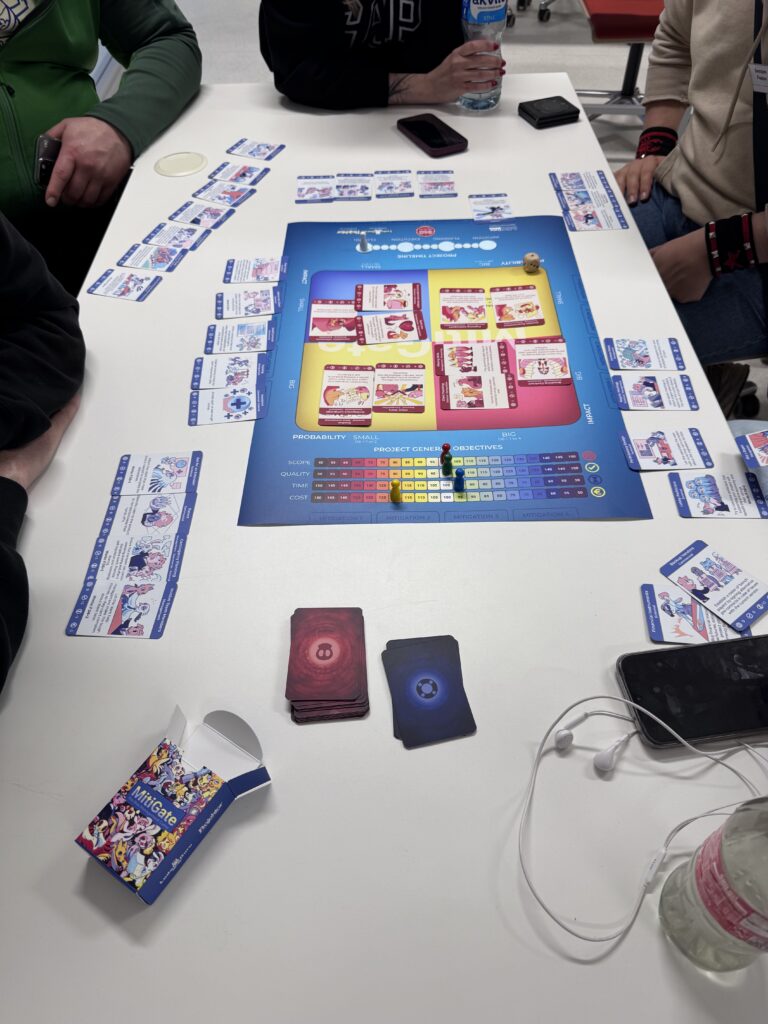
On this page, you’ll find the story behind the game, the key concepts behind its design, and additional ways to use it.
Problem
Risk management is an essential part of project management, yet most project plans treat it as an afterthought—a chapter written at the last minute with risks that rarely reflect reality. Then, when things start going wrong, everyone asks: ‘Why didn’t we think of this before?’
A similar attitude often prevails in project management training. Risk management is usually pushed to the very end of the course and, in many cases, skipped altogether. Even when it is covered, the training remains largely theoretical—focusing on frameworks rather than how to apply them in practice.
Solution
Game-Based Learning is an active method that brings theoretical concepts to life in a practical setting. The MitiGate game simulates the recurring process of risk evaluation and countermeasure planning throughout the project lifecycle—making the study of risk management more engaging and adding a sense of fun to risk assessment meetings.
Theoretical Background
The MitiGate game follows the risk management framework introduced in the Project Management Body of Knowledge (PMBOK Guide)—a PM standard followed by many organisations worldwide.
According to the PMBOK Guide, risk management consists of the following stages:
- Risk management planning
- Risk identification
- Qualitative risk analysis
- Quantitative risk analysis
- Risk response planning
- Risk monitoring and control
The MitiGate game fully covers:
- Qualitative risk analysis — by introducing a 2×2 impact-probability matrix for risk estimation.
- Risk response planning — by providing 36 pre-defined countermeasure cards.
- Risk monitoring and control — by introducing new risks to players turn-by-turn and asking them to evaluate their impact on overall project objectives.
Additionally, the other stages can easily be integrated around the game:
- Risk management planning can be addressed as a pre-game introduction to set the context and outline the methods and tools used in this game.
- Risk identification works well as a post-game activity. The gameplay session can be followed by brainstorming to identify actual risks in your current projects or organisation, using the 36 risk cards as inspiration (some are universally applicable, while others may generate new ideas).
Quantitative risk analysis is not covered in this game.
Learning Objectives
After playing the MitiGate game, players will:
- Understand the general risk management process.
- Be familiar with qualitative risk analysis.
- Identify common risks and their categories.
- Be equipped for risk response planning.
- Understand how risks and countermeasures impact project objectives.
- Improve their negotiation and argumentation skills.
Target Group
The MitiGate game was primarily designed for university students and works perfectly as a core activity in risk management classes (approx. 60 minutes). However, it has also been successfully tested and used in vocational training with adult learners, as well as an icebreaker or kick-starter for project management meetings in corporate settings.
The game is suitable for the following groups:
- University students (tested with BSc, MSc, and PhD students)
- Vocational training participants (tested)
- Project management teachers and consultants (tested)
- Project management teams, team leaders, and managers
- Any team focused on soft skills development and teambuilding
- Individuals learning risk management
- Casual strategy gamers and board game enthusiasts
Additional Materials
You can use the following presentation to introduce the game and guide players through their first round. If you like, you can also print out a one-pager with the game rules.