AmendMe is a European Parliament card simulation game.
Players (4) take the role of members of EU Parliament (MEPs) and must navigate a challenge facing EU member states (in this case, Russia’s threat to European security). Players must tackle the challenge by negotiating a legislative proposal: a directive on strengthening EU defence cooperation and security policy. Each player represents one of four political groups—Ecology, Tradition, Liberty, Solidarity—and receives a set of predetermined amendments to the legislative proposal. Players deliver public speeches to present their viewpoints, discuss the merits of each amendment, and make decisions by voting. In addition, they must respond to unforeseen in-game events (breaking news, change requests from other EU institutions, etc).
The game explains the EU legislative process to promote democratic values and civic engagement, targeting young people: students aged 16–20.
Game Components
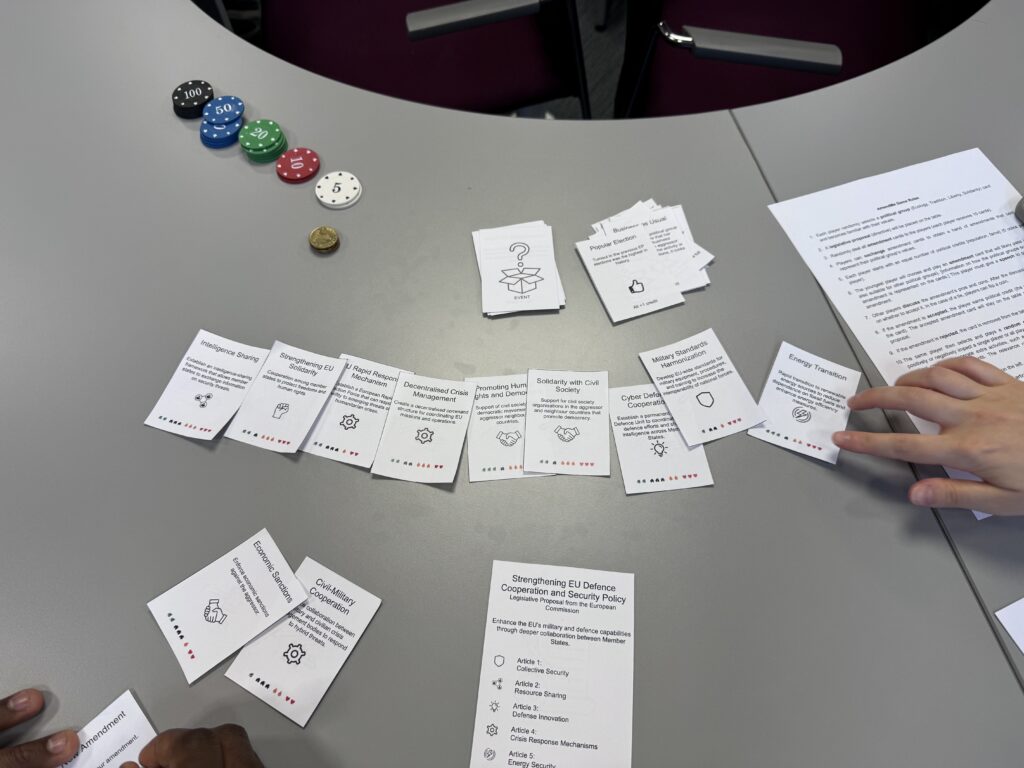
The game includes the following components:
- 4 political group profile cards
- 1 legislative proposal card
- 36 amendment cards in 7 categories (collective security, resource sharing, defence innovation, crisis response mechanisms, energy security, diplomacy, and unity, awareness and resilience)
- 36 event cards in 7 categories (bad news, good news, council intervention, stakeholders’ intervention, question from a stakeholder, question from the media, breaking news)
- 100 political credit coins (not part of the downloadable set).
Game Rules
- Each player randomly selects a political group (Ecology, Tradition, Liberty, Solidarity) card and becomes familiar with their values.
- A legislative proposal (directive) will be placed on the table.
- Randomly deal 5 amendment cards to each player. The rest of the amendment cards will stay in the deck.
- Players can trade amendment cards with each other to obtain a hand of amendments that best represent their political group values.
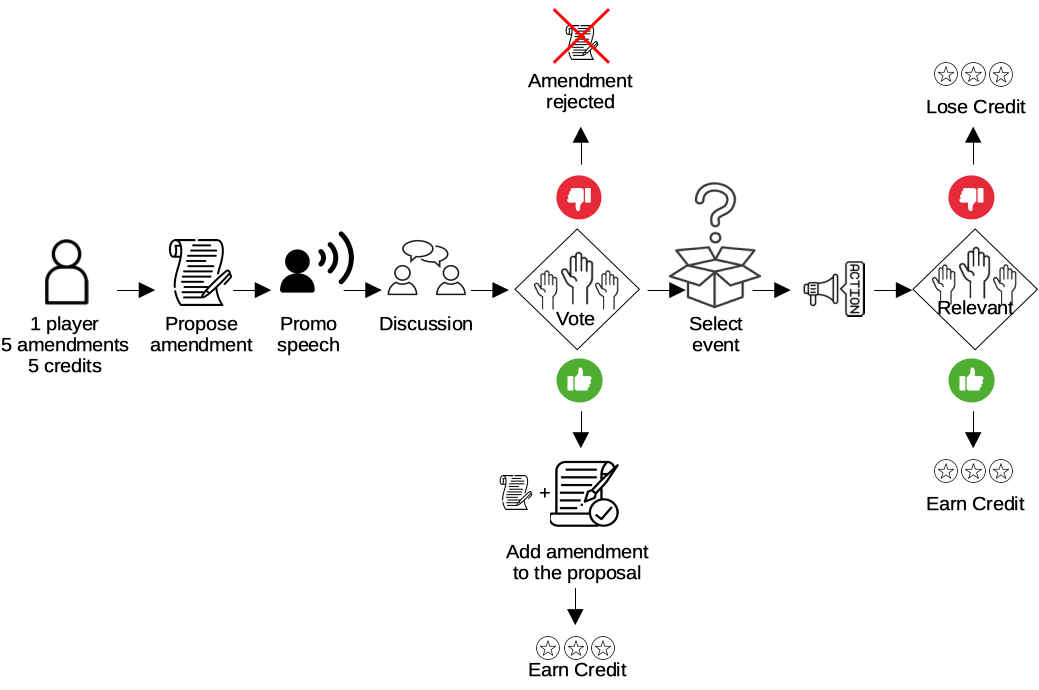
- Each player starts with an equal number of political credits (5 coins per player).
- The youngest player starts by selecting and playing an Amendment card that fits their political values (indicated by party icons) and has a good chance of being accepted by others. (Note: Amendments can only be proposed for articles that are still open. If you have no suitable card, draw one from the deck. If it still doesn’t fit, skip your turn).
- The same player must give a speech to promote the amendment.
- Other players discuss the amendment’s pros and cons. After the discussion, players vote on whether to accept it. In the case of a tie, the amendment is rejected.
- If the amendment is accepted, all players earn political credit (the number is specified on the card). The accepted amendment card will stay on the table as part of the legislative proposal.
- If the amendment is rejected, the card is removed from the table. No credit will be earned.
- The same player then selects and plays a random event card. Random events can cause a loss or gain of political credit and generate extra activities for one or all players. Detailed guidelines can be found on cards.
- The same player selects a new amendment from the deck.
- Now is the turn for the next player on the left.
- The game ends when all articles of the legislative proposal have exactly 1 amendment. The game ends with a final vote to accept or reject the legislative proposal, including its amendments (collected during the game).
- Winning condition: The player with the highest political credit has the biggest chance of winning the next elections (and thus is the winner of the game).
- Losing condition: If a player runs out of Political Credit entirely, they are expelled from the European Parliament, and the game ends for them.
Do not use “Create your Amendment” or “Create your Event” cards during the first turn of the game.